
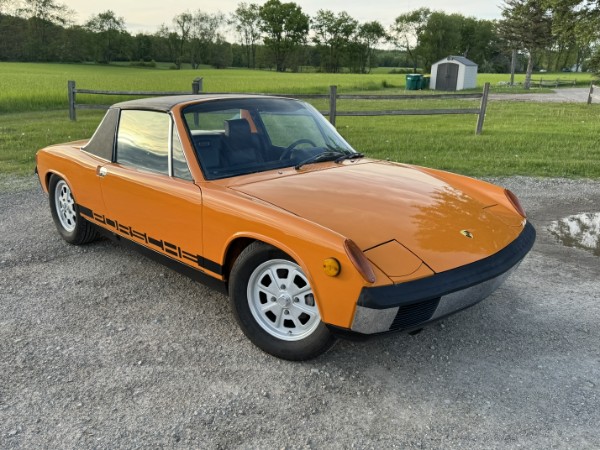
Where is it now? This one I sold locally. It can sometimes be seen driving around town after a beautiful repaint. Here’s a pic the owner sent me in 2025.
SOLD: April 2023
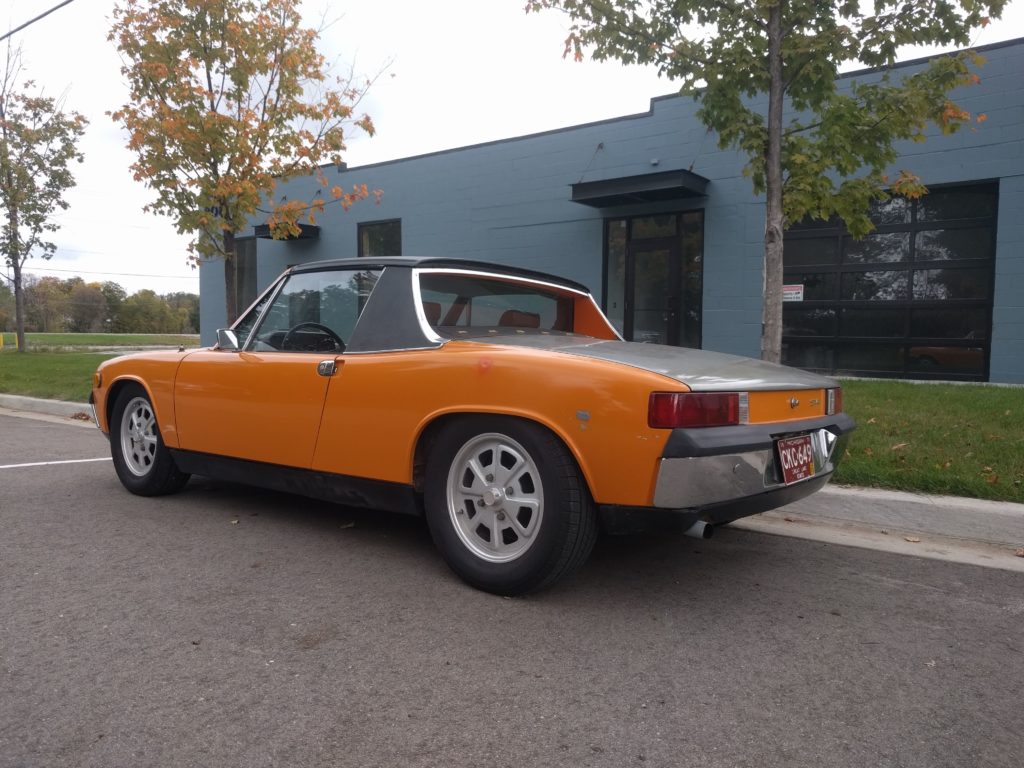
On Father’s Day in 2011 I bought this 1972 Porsche 914 1.7. A clean rust free chassis with Texas history but no motor or transmission in it. The original engine had dropped a valve and the owner pulled the drive train to fix it but never got around to it. He did however have the hell hole repaired and sprayed some primer in the rear trunk area.
I bought 2.0 liter car that was a complete basket case with no title and proceeded to do what it took to get the 2.0 swap done. This car fires right up with proper operating cold start valve and drives down the road and on the freeway the way it should. In June, I had it on the freeway at 75 mph for 30 minutes with no problems. The side shift transmission has worn first and second gear syncros but when the idle is down, it shifts up and down just fine. At a stop light, I typically do a shift to 2nd or 3rd gear before going down to 1st to line up the gear box and avoid grinding.
The numbers matching engine block comes with the car.Overview:
• Purchased on Father’s Day June 21, 2011 from Ann Arbor
• Texas car with copy of title from 1980, sold by Modern Motors San Angelo, TX
• Signal Orange L 20E over black
• Actual mileage unknown
• Matching numbers VIN 4722907344
• Hell hole repaired, otherwise no rust
• Accident damage passenger front side, replacement door from later model and fender
• Replacement rear trunk lid that is silver was added by previous owner
• Paint is tired, cracking and pealing
• Dash cracked
• Off the road for years with a dropped value and blown motor
• Numbers matching motor is apart and not in car, in storage now
• Porsche Certificate of Authenticity
Engine related work:
• Pulled gas tank, “Renu” treatment, sand blasted inside and coated with patented goo
• New fuel screen in tank
• Powder coated fuel splash catch, cad plated cap and hardware
• Added inline Bosch fuel pump
• Fuel sender is sticking, so not reading gas in tank. Fuel gauge works
• 2.0 liter motor added from rusted out 1974 Porsche 914 chronicled here in Restoration Wednesday
• New fuel lines and vacuum lines
• New cap, rotor, spark plugs, spark plug wires
• New fuel injector seals
• Blew out hard fuel lines from engine to gas tank
• Fresh oil and filter
• Fresh transmission oil 2018
• New transmission and engine mounts from URO
• Reconnected thermostat cable for cooling flaps with resources from this page
• Soaked auxiliary air regulator in Marvel Mystery Oil to free it up
• Pulled throttle body, cleaned contacts on throttle switch, reset with multi meter
• Pulled pedal cluster, checked bushings
• New throttle cable
• Adjusted valves to .006 inches intake and .008 inches exhaust
• Adjusted dwell to 46 degrees, then went to HotSpark electronic ignition
• Engine drips oil, some of it on the header which burns off in a few minutes when the cork gaskets get dry
• There is no heat. The heat exchangers are more like headers and there is no fan or engine tin to channel the heat forward
• Set timing to 27 degrees BTDC
Body and interior work:
• Added original chrome bumpers front and rear, polished with #0000 fine steel wool, pounded out some dents
• New rear top bumper seal from 914Rubber
• Added rocker panel covers, repainted Satin black
• Pulled rear tail lights, cleaned, polished lenses, cleaned contacts, fixed short
• New side marker light seals, cleaned and contacts
• Period Frankfurt radio
• Sport seats, small nick it driver seat, right bolster as pictured
• Round air horns that have a great sound
• Restored gauges but odometer not working after the pot metal gear rounded itself out again. I’ve added a photo to the gallery compressing the odometer gear so it stays tight on the shaft, which is the fix for these particular VDO gauges.
• Powder coated gauge surround
• Seat configuration is 2+1 with seat belt for middle passenger
• Replaced steering wheel with a nicer one, replaced black plastic door handle surrounds with chrome
• Replaced rear window seal and rear window-to-engine lid seal
• Replaced Targa top and bottom seal
Suspension, brakes and wheels:
• Bled brakes
• Added four Porsche Fuchs with new chrome metal center caps
• Michelin Defender 205/65 R15 94H September 2017
Over the years, I’ve lost most of my traffic as blogs fell out of favor with people turning to Insta, YouTube or TikTok. I asked AI to help. It suggested adding summaries of my Restoration Wednesday posts to my main overview page (like this one). This will help search point interested people my way. Since I’ve written over 2,600 blog posts since 2009, I asked AI to write these summaries for me. Of course, I do final edits. This, in an effort to share my story with a few more enthusiasts if they fancy some of my content. Unless noted, everything else is original to my brain. Only these summaries (below) are by AI.
On Father’s Day 2011, I bought this 1972 Porsche 914 1.7 out of Ann Arbor: a clean, rust-free Texas chassis with no motor and no transmission. The original 1.7 had dropped a valve. The previous owner pulled the drivetrain to fix it and never got around to putting it back together. He did have the hell hole repaired, which told me he cared about the car. I saw what it could be and made him an offer on the spot. I hurried back with a U-Haul trailer before someone else made him an offer he couldn’t refuse.
The plan from day one was a 2.0 liter engine swap. I had already sourced a 2.0 from a rusted-out 1974 914 basket case: no title, no future as a car, but the engine was worth saving. Well over a year before the swap, I got that motor running while it was still in the donor chassis: replaced all the fuel lines, pulled and resealed the fuel injectors, ran new vacuum lines, changed the oil, plugs, cap, and rotor. Once I knew it lived, I dropped it out and turned my attention to the carcass itself.
That donor car wasn’t going to waste. I pulled every single piece off it with intention, because the 914 community runs on good used parts and someone out there needed what this car still had. Hardware got zinc plated. Brackets got powder coated. Anything that could be rebuilt, was rebuilt. Anything that could be saved, was saved and sold on to other owners keeping their own 914s alive. When the last usable piece was gone, I cut the chassis in half and recycled the metal that was left. The engine sat waiting while I worked through everything else the ’72 needed.
And there was plenty to work through. The fuel system alone took months of methodical attention. I had two tanks that went off to Renu for their full treatment. That’s a process worth understanding: they drill access holes, sandblast the interior to bare metal, visually inspect every corner and baffle, then coat the inside with a patented liner backed by a limited lifetime guarantee. At $375 it’s not cheap, but when you consider all the variables in a fuel system on a 50-year-old car, crossing tank corrosion off the list permanently is worth every penny. I’ve seen tanks boiled and lined the old way. The Renu method is better, maybe not to the original look, but better.
With clean tanks came the fuel sender units, which are identical to the 911 units and corrode the same way: barnacle-like buildup along the float stem that picks and sands off but leaves bare metal behind. I dressed them with oil and sent one into the tank. Around the same time, a set of five Porsche 914 Fuchs arrived from eBay for $409 shipped, a bargain that took some patience to find. One rim was too far gone and became wall art. The other four polished up into solid ten-footers, which is exactly what this car deserved.
Before the Renu’d tank could go back in, the front trunk needed metalwork. Years of curb kisses had contorted the sheetmetal, and some paint prep was long overdue. There was accident damage near the trunk hinge: not rust, just a dent with a story. I pounded it out as best I could, cleaned everything back to bright orange paint, and called it ready. The time to clean is when things are apart.
Getting the tank back in took about three hours on a Saturday. First I keyed the bare metal in the trunk, hit it with a coat of primer and a coat of orange. Couldn’t leave bare metal unprotected, even though this car would never see rain on my watch. Then came reassembly with a powder-coated fuel splash catch, cadmium-plated hardware and tube fittings, a new fuel screen, and fresh felt anti-vibration pads. It’s a tight fit in there. Nothing a good pounding couldn’t handle.
Then came the summer and fall of 2016, which I basically disappeared into. Nights, weekends, every spare hour. The 2.0 motor went in and getting it there was not a graceful operation. I dragged the engine and transaxle assembly across the floor on a plastic tray, under the car on jack stands, used scissor jacks to get the assembly off the ground, balanced it on the floor jack, and cranked it up into place. It was a trick, no doubt but once connected, it fired right up. That was the good news. The not-so-good news was a persistent high idle that took many more hours to chase down, eventually traced to a stuck auxiliary air regulator that finally surrendered after a good long soak in Marvel Mystery Oil. With the engine running properly, attention shifted to putting the body and interior back together.
By early 2017, the car was getting close and the rear bumper was on the bench. The chrome was excellent but the old rubber bumper pad had deteriorated and the mounting bolts were broken and rusted solid. My $13 Harbor Freight angle grinder settled that discussion quickly. The new pad had an extra bolt hole above the license plate that required drilling the bumper, and one of the license plate lights had a broken connector that snapped during disassembly. Small stuff. I cleaned and painted the rusty license plate bracket, fitted cad-plated hardware, and assembled.
The car drove well for years between major sessions after that, while other projects pulled my attention. But in September 2020, one thing had been nagging me long enough: the rear window. The glass had worked itself loose years before, rattling and inviting in dust and road noise on every drive. I stripped the interior, spent the better part of a Sunday scraping out 50-year-old hardened putty (which, for the record, is nobody’s idea of a good time), got the surface flat and clean, laid fresh putty, reset the glass, and replaced the chewed engine lid seal while I had everything apart. Having the glass out made prying off that seal from the inside dramatically easier. The difference on the road was immediate.
January 2021 brought one of the more memorable 914 moments, though it happened entirely off the car. A toll bill arrived from Pennsylvania charging a truck for blowing a tollbooth, addressed to license plate CKC 649. I don’t own a truck. I do own a ’72 914 wearing an authentic Michigan plate with that exact number. After a polite but firm call to the Secretary of State (“to ask me to jump through hoops when I’m the victim seems a bit egregious”), a supervisor called back within the hour, arranged for the other driver to be issued a new plate, and cleared my record. It’s nice when a broken system works.
And then, finally, the fuel gauge. It had been reading full since the new sender went in the year before. I pulled it, swapped in a spare gauge to test, traced the wiring, checked everything twice. All of it checked out. Went back to the sender and looked closer. There was a bright yellow sticker over the pin hole that I had somehow missed entirely. Under it: a safety pin holding the float in place for shipping. Pull the pin, remove the sticker residue so it doesn’t contaminate the tank or filter, reinstall. Problem solved. I always read the directions. Except apparently that one time.
The car sold in April 2023 to a local buyer who gave it a beautiful repaint. The new owner sent me a photo in 2025. It looks exactly like what it always had the potential to be: a clean, sorted, honest 914 doing what 914s do best, putting a smile on whoever’s behind the wheel.